
1) First class brick weight should be not less than 3.85 kg
2) Tensile strength of the first-class brick should not be less than 3000 lbs/per inch square
3) The normal building height should be 315 centi meter.
4) The normal height of the riser should be 15 centi meter.
5) One hook length should be not less than 9D.
6) First class brick should be observed the water 1/5 or 1/6 of the brick weight.
7) Window height should be 120 centi meters
8) DBC thickness should be not less than 2.5 centi meters
9) Lintel thickness should be 15 centi meters
10) Normal and local sand FM limit should be 0.5 to 0.8
11) Cantiliver anchorage length for main steel is 69D.
12) Bend length (L) for column is minimum 300mm.
13) Chair, minimum diameter of bar is 12mm.
14) Minimum diameter of dowel bar is 12mm.
15) Lapping length should not be used for bar greater than 36mm.
16) Minimum numbers of bars for the square columns are 4 nos and for the circular column is 6 nos.
17) Longitudinal reinforcement should not be less than 0.8% and more than 6% for the gross cross-section.
18) The main bar in the slab shall not be less than 8 mm (HYSD) or 10mm (plain bar) and the distribution no less than 8mm and not more than 1/8 of slab thickness.
19) All reinforcement free from mill scales, loose rust, and courts of paints or oil and any other substances.
20) Dead Load means Self weight of Structure
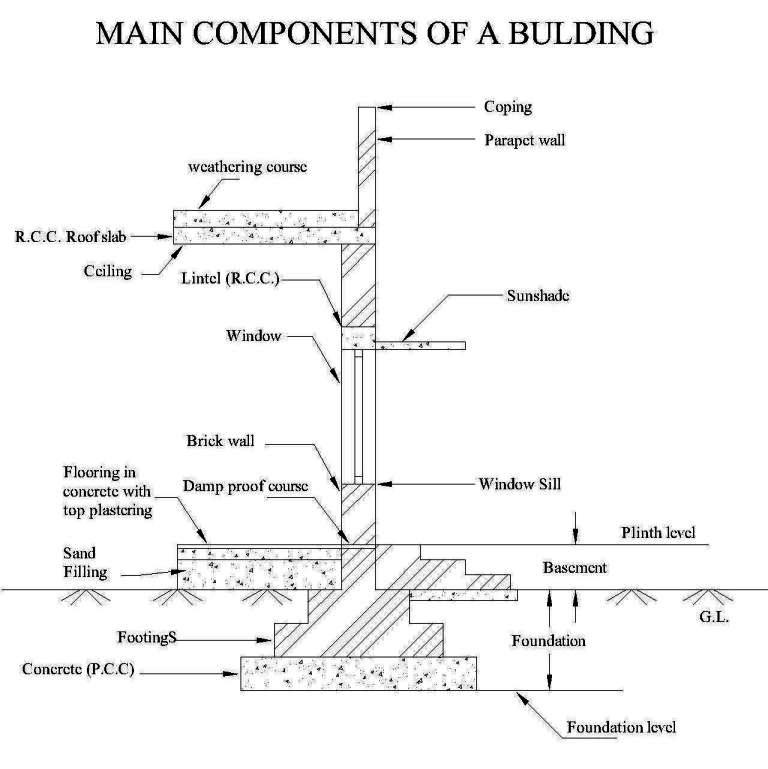
21) DPC means Damp Proof Course. The DPC thickness should not be less than 2.5cm
22) If there is more than 5% moisture content in the sand, that should not be used for concrete mix
23) The curing Period of RCC is 28days.
24) The transverse reinforcement provided in columns are called Ties
25) The transverse reinforcement provided in Beams is called as Stirrups
26) We use Stirrups in Beams and Ties in Column are provided to handle the shear force and to keep longitudinal bars in position.
27) M20 grade of concrete is used in the construction of slab.
28) Hook length should not be less than 9D. (Where D is Diamater of Bar)
29) The rise in stairs is in between 150mm to 200mm.
30) Tread in staircase is in between 250mm to 300mm.
31) The slope or pitch of the stair should be in between 25 degrees to 40 degrees
32) Unit weight of PCC is 24KN/m², RCC is 25 KN/m² ‘Steel is 7850 Kg/m²
33) Cement more than 3 months old cannot be used for construction
34) Standard Size of Brick is 19cm x 9cm x 4cm.
| Concrete Grade | Mix Ratio |
| M5 | 1:5:10 |
| M7.5 | 1:4:8 |
| M10 | 1:3:6 |
| M15 | 1:2:4 |
| M20 | 1:1.5:3 |
| M25 | 1:1:2 |
| M30, M35, M40, M45, M50, M55, M60, M65, M70 | Design Mix |
| Concrete Mixes | Slump range in mm |
| Columns, Retaining walls | 75-150mm |
| Beams & Slabs | 50-100mm |
| CC Pavements | 20-30mm |
| Decks of bridge | 30-75mm |
| Vibrated Concrete | 12-25mm |
| Huge Mass constructions | 25-50mm |
RCC – Reinforced Cement Concrete | AE – Assistant Engineer |
B.M – Benchmark / Bending moment | APM – Assistant Project Manager |
BHK – Bedroom, Hall, Kitchen | BOQ – Bill Of Quantities |
BWK – Brick Work | W.C – Water closet. |
CC– Cement concrete / Centre To Centre | C.I.Sheet – Corrugated Iron sheet. |
CE – Chief Engineer | CPM – Critical path method. |
D – Diameter | D.L – Dead load |
DPC – Damp proof course. | DPR – Daily Progress Report |
FL – Floor Level | FOC – Factor Of Safety |
GL – Ground Level | JE – Junior Engineer |
Kg – Kilogram | L.L – Live load. |
MFL – Maximum Flood Level | N – Newton |
OPC – Ordinary Portland Cement | PCC – Plain Cement Concrete |
PERT – Programme Evaluation and Review Technique. | PL – Plinth level. |
QC – Quality control | RCC – Reinforced Cement Concrete |
RMC – Ready Mixed Concrete | TDS – Total Dissolved Solids |
W.C – Water closet. | WO – Work Order |
The slope of staircase varies from 25° to 40° as per the Indian standard code 456-2000
Weight of 1 cement bag is 50 kg so the volume of 1 cement bag is 0.0347 m³ or 1.23 CFT
Expiry date is 3 month after the bag is packed.
Foundation is provided in order to safely distribute the load of structure in the soil
Shallow foundation
Deep foundation
M20
Side of wall column and Outer side of beam shuttering is removed after the 24 hrs to 48 hrs of concrete. Beam soffits shuttering is removed after 7 days. Slab shuttering is removed after 3 days. Remove the props of the slab after 21 days of span greater than 6m and after 14 days of span less than 6m.
Compressive strength test, Slump Test, Water absorption test, Water permeability test
78.5 KN/m³ is the unit weight of steel.
The unit weight of concrete of RCC is 25 KN/m³ and PCC is 24 KN/m³
First class Brick – 105 kg/cm²
Second class Brick – 70 kg/cm²
Fire Brick – 125 kg/cm²
Initial setting time is 30 Minutes And the final setting time of cement is 90 minutes.
Spraying, Wet covering of Surface, ponding, Curing chemicals, Steam curing, Sprinkling
Stirrups are used in beams to resist shear force
Pile foundation is acquired when the soil bearing capacity is less than 24 KN/m³
Height of each floor is 3 M
It is a process in which a mixture of cement and sand proportion of 1:3 is shooted on the ground surface with the help of gun pressure of 2 to 3 kg/cm²